How can we help the helpers?
In the international development sector, good work isn’t just about getting the tasks done – it’s also about knowing whether our efforts are improving the lives of the people we aim to serve.
And to know if the work is positively making a difference, the people who focus on monitoring, evaluation, accountability, and learning (MEAL) play a critical role.
Monitoring tells us what is happening, evaluation helps us understand what it means, accountability ensures we answer to those who trust us to do this work, and learning helps us decide what to do next.
And all of this helps us to be accountable to the participants and communities we serve – along with Canadian donors such as individuals, churches, and the government – and to make any needed adjustments in helping people take solid steps out of poverty.
MEAL is essential in every context – but “success” can look very different from one place to another. For example, most agriculture projects aim at increasing production and improving food systems, but it’s also important to consider how the project affects the labour inputs, the net profit and income, and the division of labour between men and women of the household.
Similarly, there are projects where the aim is to diversify the diet available to the family or to sustain current levels of production in the face of the effects of climate change. In this case, the variety of crops grown or the resilience of the crop during drought is just as important as increasing production. This is why understanding local priorities and contexts is so important.
Our MEAL work is a collaborative effort between local partners, members, technical advisors, and Canadian Foodgrains Bank staff. Most of this work happens remotely – through feedback on project proposals and reports, network-wide online learning sessions, and written guidance materials – while also encouraging peer-to-peer learning among partners, and visiting partners where possible to better understand on-the-ground realities.
And for many years, these times of learning in our network happened through reading reports, and online meetings, or through sessions incorporated into other gatherings.
But nothing compares to focused face-to-face learning in a wider group setting, and over the past few years, we’ve heard numerous requests across our network of member agencies and partners to facilitate in-person MEAL support.
Because while online engagement has its strengths, including being easier to organize, drawing in more people, and being low-cost, there are a few key drawbacks that can limit the full extent of our learning:
- difficulties in holding in-depth discussions,
- language barriers become more pronounced,
- wi-fi connection issues can hamper the flow of learning,
- online meetings often only allow facilitators and learners to address one topic because of the short timeline, and
- the ability to develop meaningful relationships with implementing partner colleagues is also limited by an online format.
On the other hand, not only does an in-person format deepen learning through discussion, but also helps reinforce online learning and written guidance by building trust, strengthening relationships, and making it easier for partners to continue sharing knowledge after the event. Many of our members’ partners are doing cutting edge work in their fields, and this year, we wanted to be more intentional about bringing partners into the same space to learn from each other.
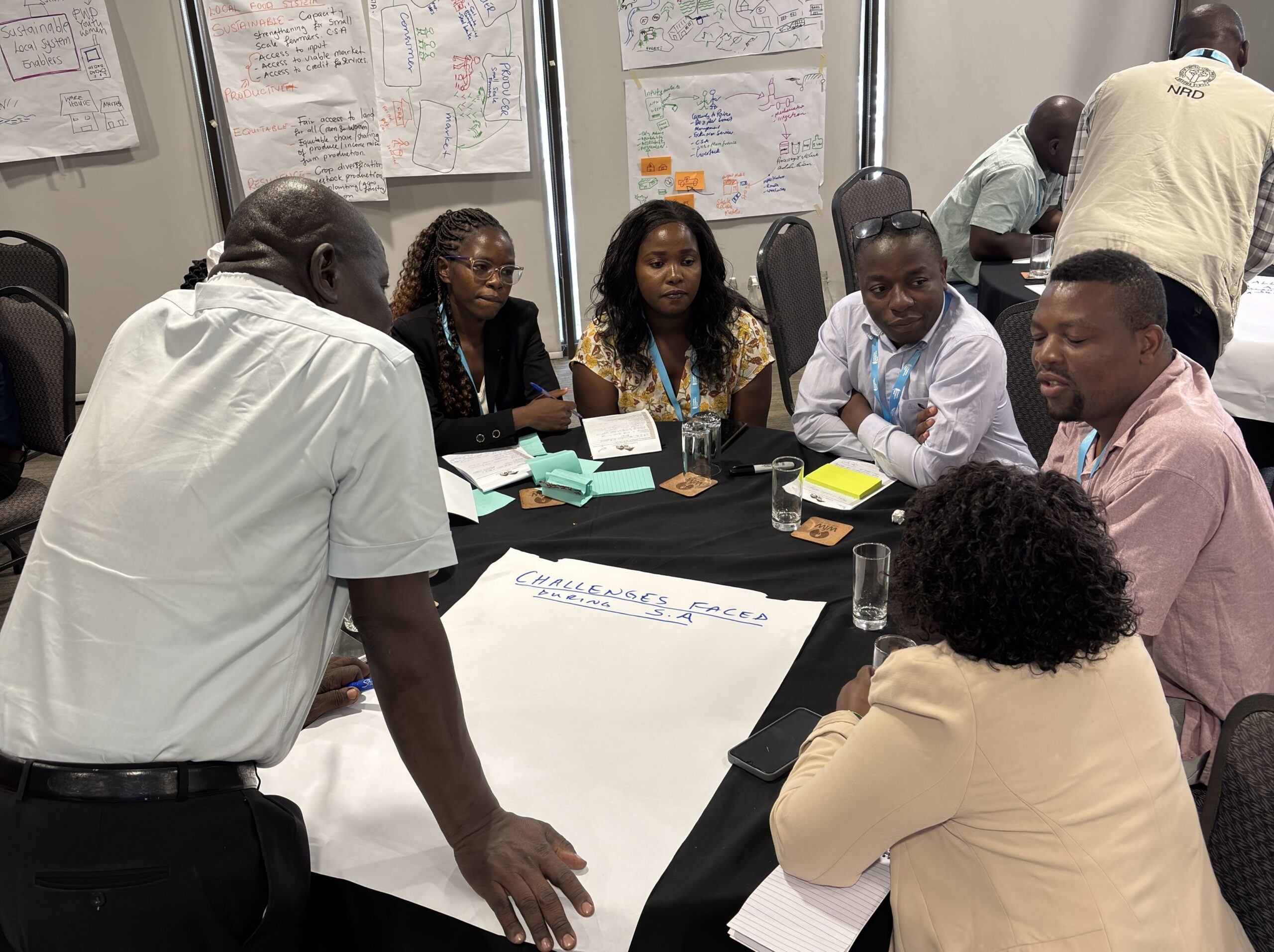
As a result, we hosted five in-person MEAL workshops over the course of seven months in 2025-26, in Cambodia, Ethiopia, Kenya, Rwanda, and Zimbabwe:
- 207 total attendees across the five workshops
- 150 partner staff representing 84 local partners
- 14 of our 15 member agencies had partners attending the workshop
- Partner attendees came from 26 countries
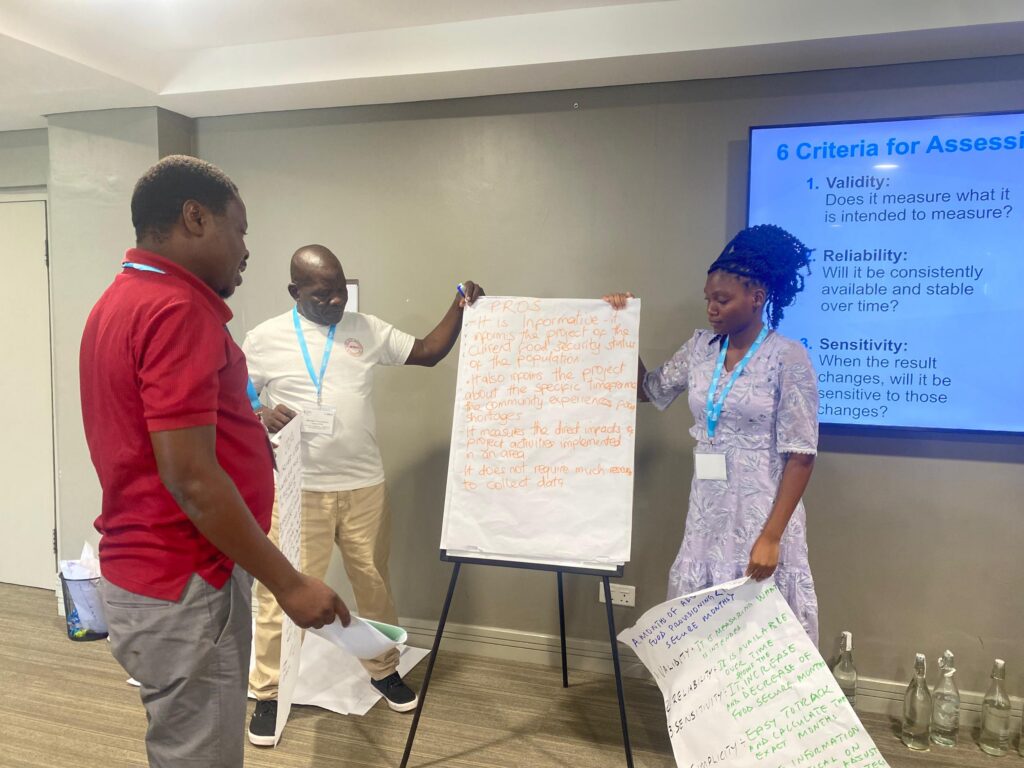
About 28 partner staff attended the in-person MEAL workshop in Rwanda, including those who travelled from Malawi, Zambia, and Zimbabwe. (Photo: Dwayne Hodgson)
To cultivate relevant workshops, international partners were asked a series of in-depth questions to help us understand their particular needs and priorities. In addition, these surveys provided a source for tapping into the attendees’ expertise for enhanced peer-to-peer learning.
Because when we highlight partner voices and provide an intentional space for partners to learn from each other’s experiences, we develop more relevant, context-driven solutions, strengthen mutual ownership and trust, and enable knowledge exchange that is grounded in lived experience rather than a one-directional transfer of expertise.
Reflections from the Cambodia gathering
In Cambodia, 56 partner, member, and Foodgrains Bank staff representing nine countries gathered to learn from each other, including Natasha Fateh, who co-presented sessions on behalf of CWSA Pakistan (partner of Foodgrains Bank member Presbyterian World Service & Development).
The experience of sharing on CWSA’s quality and accountability mechanisms – particularly its complaint and feedback mechanisms (CFM) – was a helpful opportunity for encouragement and reflection, says Natasha. Not only was it helpful for other sector colleagues, but the discussions about reporting in agriculture and livelihoods projects encouraged CWSA to improve their own systems.
“Colleagues from India, Nepal, and Bangladesh participated in the discussion and showed strong interest, especially those in the process of developing their own CFM systems. They found the exchange practical and useful, and it created a valuable opportunity for peer learning across contexts.
“Following the exchange, we strengthened our internal learning processes by formalizing reflection sessions after key monitoring activities. We have also shifted greater focus toward tracking outcome-level changes, rather than primarily concentrating on outputs.”
For Natasha’s colleague Rafat Malik, the most valuable aspect of the in-person meeting in Cambodia was “the opportunity for deep, practice-oriented exchange with peers facing similar challenges across diverse contexts” – through hands-on, practical group work that is impossible to replicate fully in online-only meetings.
“While online meetings are efficient for information sharing, the in-person gathering enabled much deeper engagement, trust-building, and contextual understanding… discussions were highly relevant and grounded in real implementation issues, such as participant tracking, data quality, calculating unique participants, and balancing reporting requirements with field realities.
“It also helped strengthen professional relationships across the network and provided a clearer appreciation of how different contexts shape MEAL approaches. Overall, this level of interaction and peer learning is difficult to replicate in large online meetings.”
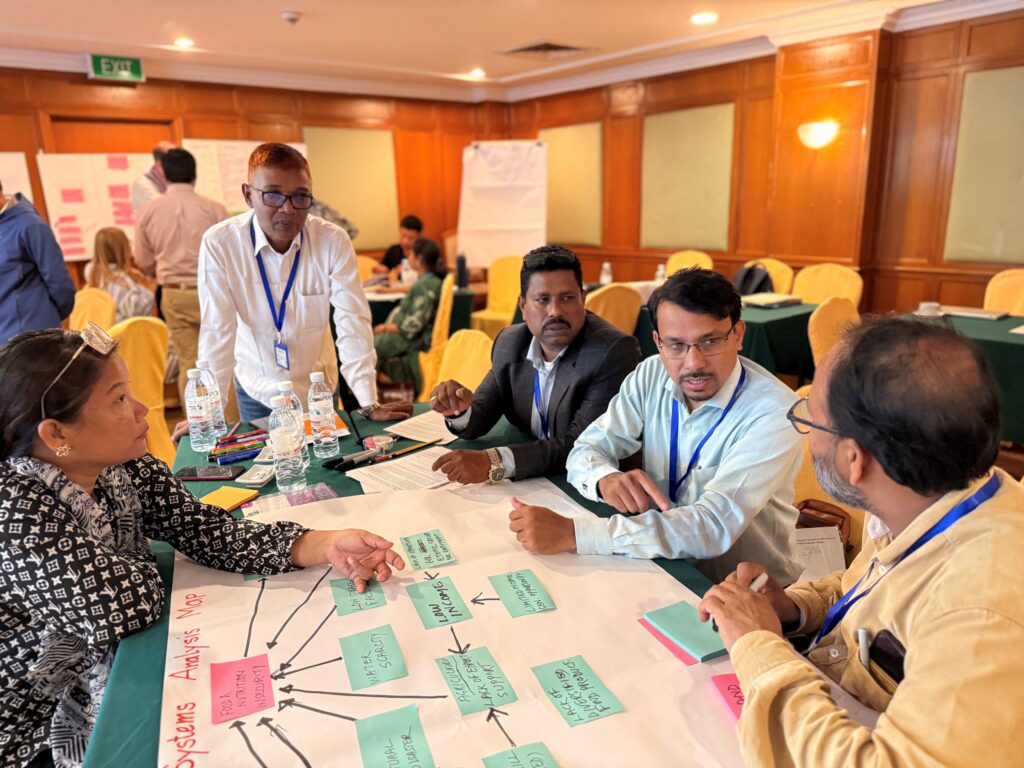
In Cambodia, partners from nine countries across Asia had the opportunity to meet in person and discuss their work on strengthening monitoring, evaluation, accountability, and learning systems. (Photo: ADRA)
Building on the learnings and momentum of the in-person workshops
While we recognize that partners’ time is limited and that in-person sessions require both time and financial investment, they represent a strategic investment in stronger outcomes. Our hope was that making this kind of investment regularly would help deepen the quality of our MEAL work, so that we may see even more consistent and focused data, and more useful and practical analysis of that data across our portfolio.
Building on this momentum, these workshops are just one part of a broader, ongoing approach to learning, ensuring we keep improving how we serve communities together.
So what’s next?
As part of our ongoing commitment to improving our effectiveness and the strength of the Foodgrains Bank network, we’re now in the process of:
- Conducting follow-up surveys with workshop participants to understand their latest learning needs, how the workshop content is being applied in their local contexts, and what we need to tweak for future events
- Mapping out a clear strategy and timeline for prioritizing both in-person and online learning sessions, including a partner gathering in the Middle East when regional stability allows
- Finding new ways to support peer-to-peer learning for partners, such as more partner project case studies, panel discussions on real implementation challenges, and practical sessions hosted by partners on their specific areas of expertise
- Providing follow-up learning resources and opportunities, such as webinars, offering refresher trainings every 1-2 years, online courses, and creating ongoing learning platforms (or ‘communities of practice’) for sustained capacity building rather than making it a one-off event
- Encouraging the in-person gathering of partners who live within the same country, with regular peer exchange and platforms to share context-specific challenges, tools, and lessons learned.
When we truly listen to and learn from communities – asking meaningful questions, checking assumptions, and digging deeper into how and why things are happening – we gain valuable insights that can be shared across the entire Canadian Foodgrains Bank network, building on the wisdom and deep experience of partners, and ultimately making our efforts more effective as we work towards a world without hunger.