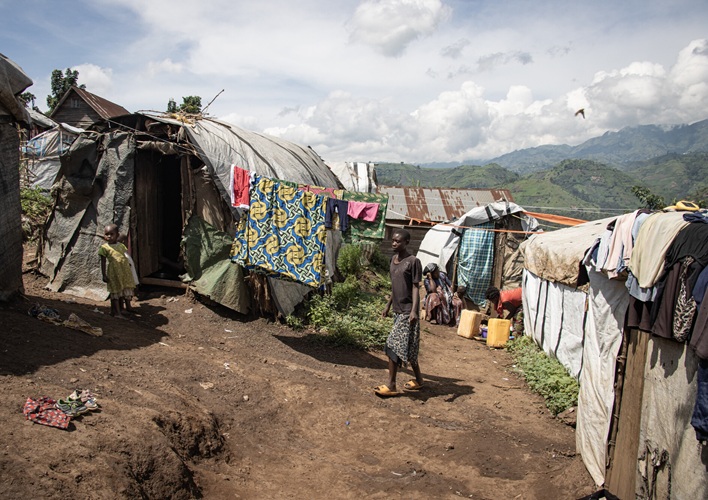
By the end of 2025, an estimated 82.2 million people were displaced within their own countries – over twice as many as 7 years ago as global crises deepen.
This concerning number – equivalent to twice the population of Canada – was revealed in the just-released Global Report on Internal Displacement 2026, published by the Internal Displacement Monitoring Centre (IDMC).
While this is a slight decrease from last year, the global figures remain close to last year’s record levels.
The scale of displacement has grown dramatically over the past decade, driven largely by conflict and increasingly frequent weather shocks such as drought and flooding. And for people forced from their homes by these factors, accessing food, water, and basic services becomes very difficult, leading to an increase in hunger.
Displacement often strikes without warning, says Canadian Foodgrains Bank senior humanitarian manager Stefan Epp-Koop – forcing people who once had stability to make impossible choices in moments of crisis.
“I’ve been struck by how often we hear the people in our projects tell us about the lives they were forced to leave behind – a successful business, a productive farm, a future they had worked hard to build,” he says.
“No one expects to become displaced. Yet in an instant, people are confronted with an urgent, potentially life-or-death decision to flee for their safety. Many lose everything they owned and find themselves stuck in displacement for years, in situations they never wanted or imagined. Our members’ partners stand alongside these families, helping meet immediate needs while also restoring dignity and hope as people work to rebuild their lives.”
The number of people displaced by conflict or violence this year rose 60% from last year.
In 2025, conflict and violence were responsible for the vast majority of internal displacement worldwide, forcing an estimated 68.6 million people – 83 per cent of all internally displaced persons (IDPs) – to flee their homes. Armed conflict remains the primary driver of both displacement and hunger, and many people in the most affected countries were uprooted repeatedly – making it even more difficult for families to recover.
Sudan alone accounted for 9.1 million IDPs – the most of any country at the end of 2025. In Gaza, nearly the entire population remains displaced as conflict continues.
“For millions of people, displacement has shifted from a short-term emergency to a relentless daily struggle that continues to intensify,” says Foodgrains Bank executive director Andy Harrington, who travelled to Sudan and South Sudan in April to meet refugees and IDPs displaced by the world’s largest humanitarian crisis. “This trip was an experience that underscores the urgency of standing up for human dignity, social justice, and the protection of fundamental rights.”
“The support of the international community matters, not only in responding to urgent hunger, but in standing with people who have endured far too much for far too long,” Harrington adds. “They deserve to be heard, to be valued, and to receive the same dignity and support we would demand for our own communities. In a world full of competing crises, turning away is a choice we cannot make. At a moment of such profound human need, our shared humanity calls for attention, action, and unwavering solidarity.”
At Foodgrains Bank, 89 per cent of our humanitarian assistance and acute malnutrition treatment in 2025-26 went to projects serving people affected by displacement. Our members and their local partners committed to serve 314,314 people in projects that included support for displaced people in places like Afghanistan, Gaza, Haiti, and Sudan.
Foodgrains Bank also provides assistance to displaced people through a range of other approaches, including nexus programming and agriculture and livelihoods projects.