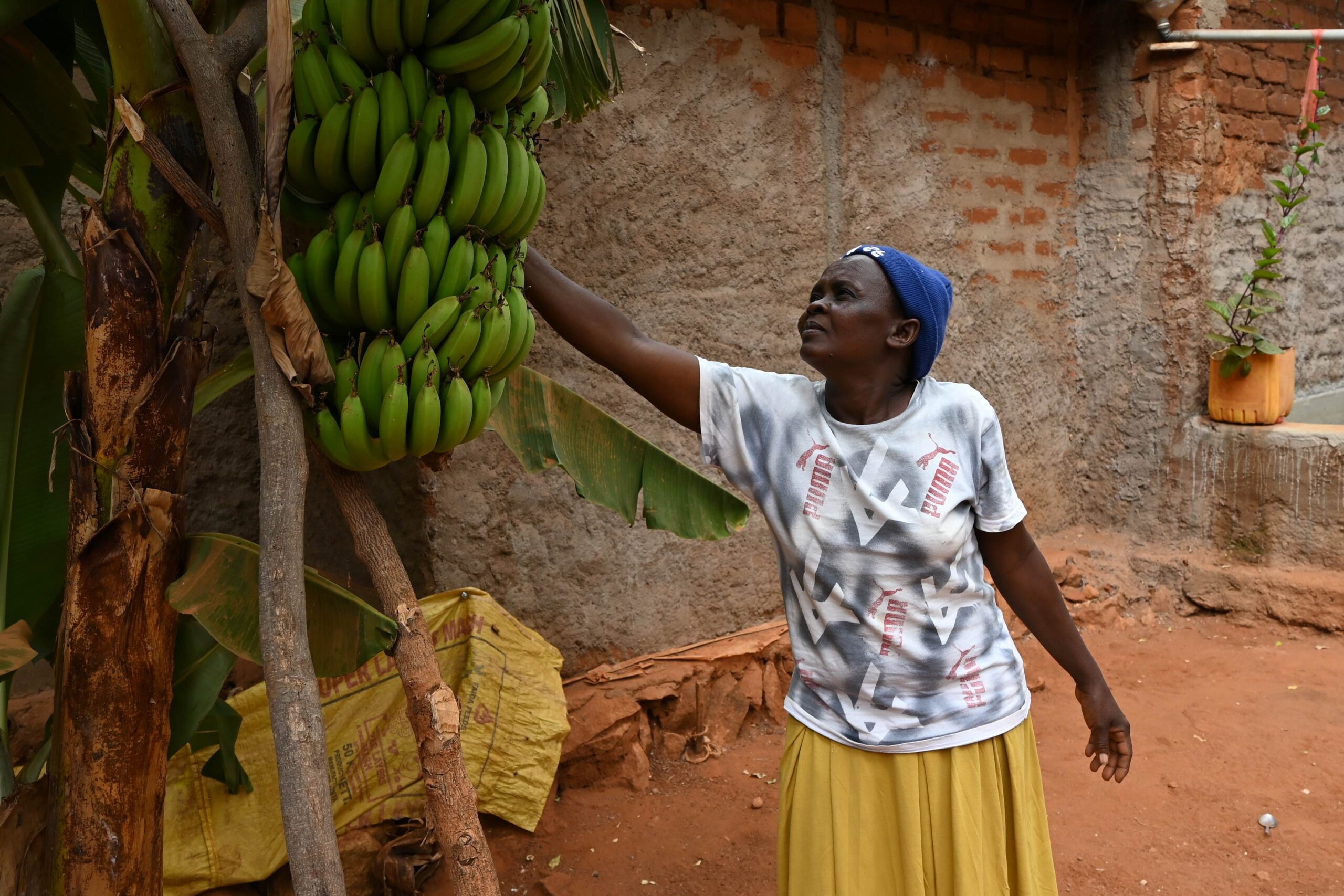
From her perch on a vibrant green plastic chair under the cooling umbrella of a shade tree in Kenya, Dorcas Matheka has a great view of her growing farm enterprise.
She can see the 40 healthy banana trees planted just a few months earlier. Beside her house, a small vegetable garden, with kale, spinach, coriander and tomatoes, flourishes in burlap sacks filled with rich soil. A mesh fence keeps the growing herd of goats away. Tethered cows lounge under a tree. Newly harvested castor beans and cowpeas dry on a mat in the sun. And if she listens closely, she might be able to hear the buzz of bees as they pollinate plants and return to her bee hives nestled high in nearby trees. The bees also sip water from a concrete fish tank, tucked behind her house, which she has filled with 40 mudfish. A layer of azolla, a fast-growing aquatic fern, grows on the water and feeds her chickens and fish.
A vibrant diversified farm—and a diversified diet—are plainly visible here. Dorcas, a married mother of five children aged 14-22, makes sure her family is eating enough nutritious food. Then she sells the surplus. “There is great change,” she says. “I used to [pay] school fees from selling produce. Now I can sell fish. I can sell honey. I can sell poultry. I can sell goats.”

Dorcas with three of her five children, from left to right: Andrew, Virginiah, and Leonard. (Photo: Carol Thiessen)
In 2023, Dorcas joined a project led by Utooni Development Organization (UDO), supported by Mennonite Central Committee (MCC) Canada, to improve her livelihoods in sustainable ways and contribute to a more resilient community. The local project is part of Canadian Foodgrains Bank’s Nature+ program, funded through the Canadian government, which is building more resilient food systems and communities in a set of natural landscapes in Ethiopia, Kenya, Mozambique, and Zimbabwe.
Dorcas courageously joined the training sessions, learning with others, experimenting in her own farm, and working collaboratively. “Even the children see the change in our family,” she says. ‘We are sharing both the [farm and household] roles.”
Susan Musyoka, a technical officer with UDO, says the change comes from within. While UDO provides training and other support, Susan said they encourage community members to take ownership of their own futures. “With the change of the mindset, the farmer can use the local resources that they have to fight the challenges they have in their households.”

Kitchen garden with kale, enclosed in mesh to keep animals out. Dorcas is also growing spinach, coriander, and tomatoes. (Photo: Carol Thiessen)
Through the project, Dorcas joined a Village Savings and Loans Association (VSLA), with 37 members, where she and other farmers can pool their savings, take small low-interest loans, and support each other.
Dorcas used her training and loans to plant dozens of fruit trees on the nine acres she farms, expand herds of small livestock, grow honey production, and experiment with new crop associations and techniques. UDO is currently pursuing linkages with a cooperative that aggregates and processes honey for higher returns to the farmers.
Of all the things Dorcas has tried, she is especially proud of her burgeoning fish business. She saw tilapia on the menu of a local hotel and spotted a market opportunity. Her first attempt at raising tilapia failed, but she has embarked successfully on mudfish (similar to a catfish), which she sells to neighbours. With new knowledge and money in pocket, she plans to reinvest in tilapia soon. And she’s helping others too. “Dorcas started the fish farming,” says Susan. “By now we have five more [farmers] who have copied her and learned from her.”
Dorcas is also pleased with how she has gained the respect and support of her husband, who works outside the home selling water. The gender training provided by UDO, together with the mostly male gender champions, has helped them both. “I come back and find my husband has cleaned the house and washed the dishes. This is a bit different,” she says. “Now I’m being listened to, compared to before. I give an idea and we discuss together and then my husband listens to me.”
With her new income, she has improved her house, purchased solar panels for the roof, and bought a table and chairs. Before she didn’t invite others over, because she felt she had so little to share. “I think I was shy because I didn’t have anything,” Dorcas says. “So how would I go and have confidence in speaking to others? But now the VSLA can meet in my home!”
This article was written by Carol Thiessen, Canadian Foodgrains Bank senior policy advisor